astronomy/ai produced the result/The Astrophysical Journal 2025 · v2
Hubble and Webb images reveal a candidate massive touching binary star in WLM
Archival Hubble and Webb images of the nearby dwarf galaxy WLM turned up a star that dims and brightens every 1.0934 days. A neural network trained to imitate a slow binary-star model let the team fit its light curve.
spectrum · one line per step, placed by what the step does · bright lines used AI
A Low Metallicity Massive Contact Binary Star System Candidate in WLM Identified by Hubble and James Webb Space Telescope Imaging
The Astrophysical Journal, 2025
doi:10.3847/1538-4357/adca39 · record aix-00037 v2 · checked 2026-10-08
- AI was for
- Simulation surrogate
- Model family
- Multilayer perceptron
- Checked by
- Held-out
- Code
- not reported
The finding the paper is about came from the AI.
What this research was about
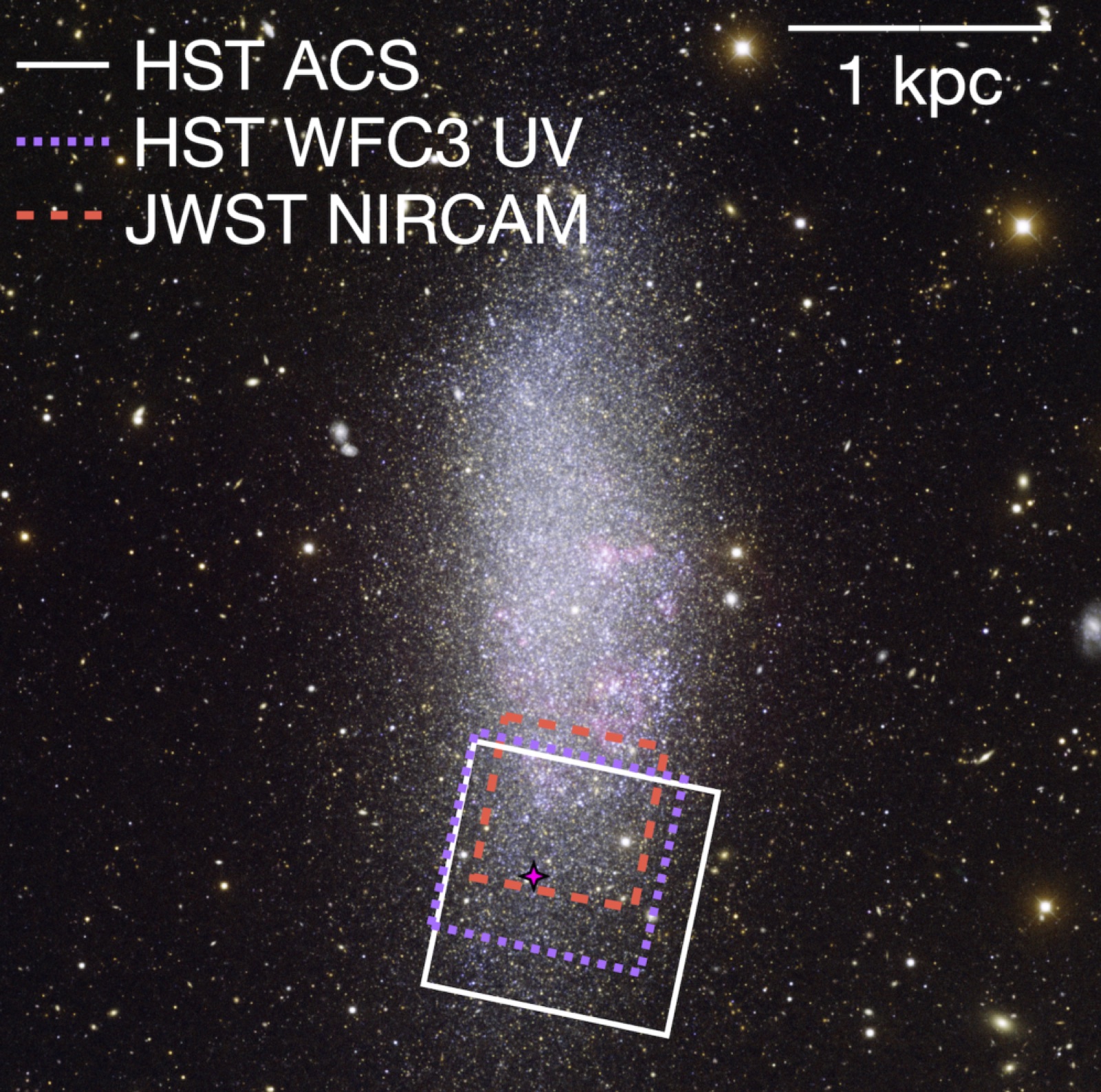
Most massive stars come in pairs. When two such stars orbit very close together, they can swell until their surfaces touch and they share a common envelope of gas. These contact binaries matter for understanding how heavy stars end their lives. They are easiest to study in galaxies poor in heavy elements, because the early universe was poor in them too. WLM is a small, metal-poor dwarf galaxy near our own. The difficulty is distance: individual stars there are faint, and the only clue to a pair is a regular dip in brightness as one star passes in front of the other.
The researchers went back to images of WLM already taken by the Hubble and James Webb space telescopes, measured the brightness of stars in each exposure, and looked for any whose light rose and fell on a steady cycle. One candidate, named WLM-CB1, repeats every 1.0934 days. They then tried to work out the two stars' temperatures, masses and sizes from the shape of that repeating light pattern.
Where AI came in
Working out what a binary looks like from its light curve means running a physics code, PHOEBE, that predicts the brightness pattern for a given set of stars, then comparing with the data. Searching the full range of possible stars needs enormous numbers of such predictions, and each one is slow. So the team ran PHOEBE around 45,000 times per filter to build two sets of practice examples, one assuming the stars touch and one assuming they do not, and trained a simple layered neural network on each. The network learned to produce the same light curves far faster, with a median error under about a thousandth on the normalised data.
The trained networks then stood in for PHOEBE inside the fitting itself, letting a statistical search explore temperature, mass, tilt, period and other quantities. The reported stars, at 29,800 K and 16 solar masses and 18,000 K and 7 solar masses, come from that fit. The same search also weighed the touching and partly separated pictures against each other; the two scored almost equally, which is why the system is reported only as a candidate.
Written by AIxSci from the checked record below, to give context for readers outside the field. It is not part of the record.
The work
Technical · from the record
Archival HST and JWST time series imaging of the metal-poor dwarf galaxy WLM was searched for periodic variables, yielding WLM-CB1, an eclipsing binary candidate with a period of 1.0934 days from a multi-band Lomb-Scargle periodogram. A fully connected neural network was trained on light curves generated by the eclipsing-binary code PHOEBE and used as the forward model in nested sampling fits of the panchromatic light curves. The fit gives two hot main-sequence stars with T1 = 29800 K and M1 = 16 solar masses, and T2 = 18000 K and M2 = 7 solar masses, with a fillout factor of 0.02. Bayesian evidence for contact and semi-detached models was nearly identical, so the system is reported as a candidate, and MESA binary evolution models were used to explore evolutionary paths.
How AI was used
PHOEBE was used to generate roughly 45,000 synthetic light curves per filter for each of two model grids, one parameterised as a contact binary and one as a detached system, by randomly sampling the binary parameters within ranges set from the periodogram and CMD position. Fluxes were converted to magnitudes with pyphot zero-points and both parameters and light curves were normalised. A separate fully connected neural network was trained on each grid in PyTorch, with architecture and hyperparameters selected using Optuna: five layers in total with three hidden layers, a learning rate of 10^-4 and a batch size of 32, with 80 per cent of the sample used for training and 20 per cent for validation. The trained network served as a fast emulator of PHOEBE inside the likelihood of a reactive nested sampling run with UltraNest using 400 live points and the generate-mixture-random-direction step sampler, producing posteriors over temperature, mass, temperature ratio, inclination, mass ratio, period, fillout factor and extinction, and a Bayesian evidence for each physical scenario. The network was also used to produce synthetic light curves illustrating the effect of varying each parameter individually.
The shape of the work
Structural · the record, drawn
no AI
Reduce archival HST and JWST time series imaging
Cleaning, filtering, normalising or labelling data already obtained.
A reduction from this point on was performed via the DOLPHOT package for NIRCam.where the paper describes this · verbatim
no AI
Search light curves for periodic variables
Reducing a candidate set by filtering or ranking, in a single pass.
We then use multi-band L-S periodogram in astropy to find any light-curves in the HST archival data that may show periodic signal.where the paper describes this · verbatim
no AI
Estimate period and temperature priors
Cleaning, filtering, normalising or labelling data already obtained.
the L-S power spectrum yields a period of 1.0934 days and a FWHM of 0.07where the paper describes this · verbatim
no AI
Generate PHOEBE light-curve training grids
Numerical or physics simulation, including where a learned surrogate replaces it.
Using PHOEBE, we generate ∼45,000 light curves for each filter in phase space.where the paper describes this · verbatim
AI
Train neural network emulators of PHOEBE
Fitting model parameters, including fine-tuning an existing model. The AI stood in for simulation.
We opt for a fully connected neural network (NN), using PyTorch and Optuna.where the paper describes this · verbatim
AI
Fit observed photometry by nested sampling with the emulator
Iterative search over a space. The AI stood in for simulation.
we use the nested sampling Monte Carlo algorithm MLFriends as part of the UltraNest packagewhere the paper describes this · verbatim
no AI
Derive remaining stellar parameters
Running a trained model over new data to predict, classify or score.
Using PHOEBE and the underlying atmosphere models we compute the radius of the primary (R1), surface gravity of the primarywhere the paper describes this · verbatim
no AI
Match MESA binary evolution models to fitted parameters
Numerical or physics simulation, including where a learned surrogate replaces it.
We use the 1D stellar structure and evolution code MESA to explore potential evolutionary paths of WLM-CB1.where the paper describes this · verbatim
What the record says
Technical · every part carries its own basis
+ in the paper~ our reading− not reported
How to read the quotations. A quotation shows where the paper describes something. It does not quote every value beside it: one passage locates a part of the work, and values without their own quotation are our reading of that passage.
The binary's reported stellar parameters come from fitting a neural network emulator of PHOEBE to the photometry; the central result depends on that surrogate.
we train a neural net framework to emulate PHOEBE, resulting in significantly reduced model generation time with minimal loss in accuracywhere the paper describes this · verbatim
We use 80% of our sample to train and 20% to validate. Our median approximation error peaks under ∼ 10−3 for our normalized data set.where the paper describes this · verbatim
What this paper did not report
Technical · absence is published deliberately
- CodeWhether the code is available is not stated.
- Trained model weightsWhether the trained model is available is not stated.
- DataWhether the data are available is not stated.
- ComputeThe hardware or time used is not stated.
- How many were testedThe paper gives no count of what was tested.
- Version of Fully connected neural network emulator of PHOEBE (contact-binary grid)Which version of the model was used is not stated.
- Version of Fully connected neural network emulator of PHOEBE (detached/semi-detached grid)Which version of the model was used is not stated.
About this article
Record aix-00037, version 2, checked by a person on 2026-10-08. The record describes the paper; it does not assess whether the paper's findings are right. The paper is published under CC-BY; quotations are at most 25 words. How we work · Report an error