materials-chemistry/ai produced the result/ · v2
Seven machine-learned water models test how density functional choice shapes water's behaviour
Researchers trained a separate machine learning force field for each of seven quantum-mechanical descriptions of water, then used them to simulate liquid water and work out its structure, entropy, viscosity and diffusion.
spectrum · one line per step, placed by what the step does · bright lines used AI
From Local Structure to Thermodynamics and Transport of Water with Machine Learning Force Fields
doi:10.48436/8j5e2-jx429 · record aix-00142 v2 · checked 2026-10-09
- AI was for
- Simulation surrogate
- Model family
- Gaussian process
- Checked by
- Benchmark7 tested
- Code
- available
The finding the paper is about came from the AI.
What this research was about
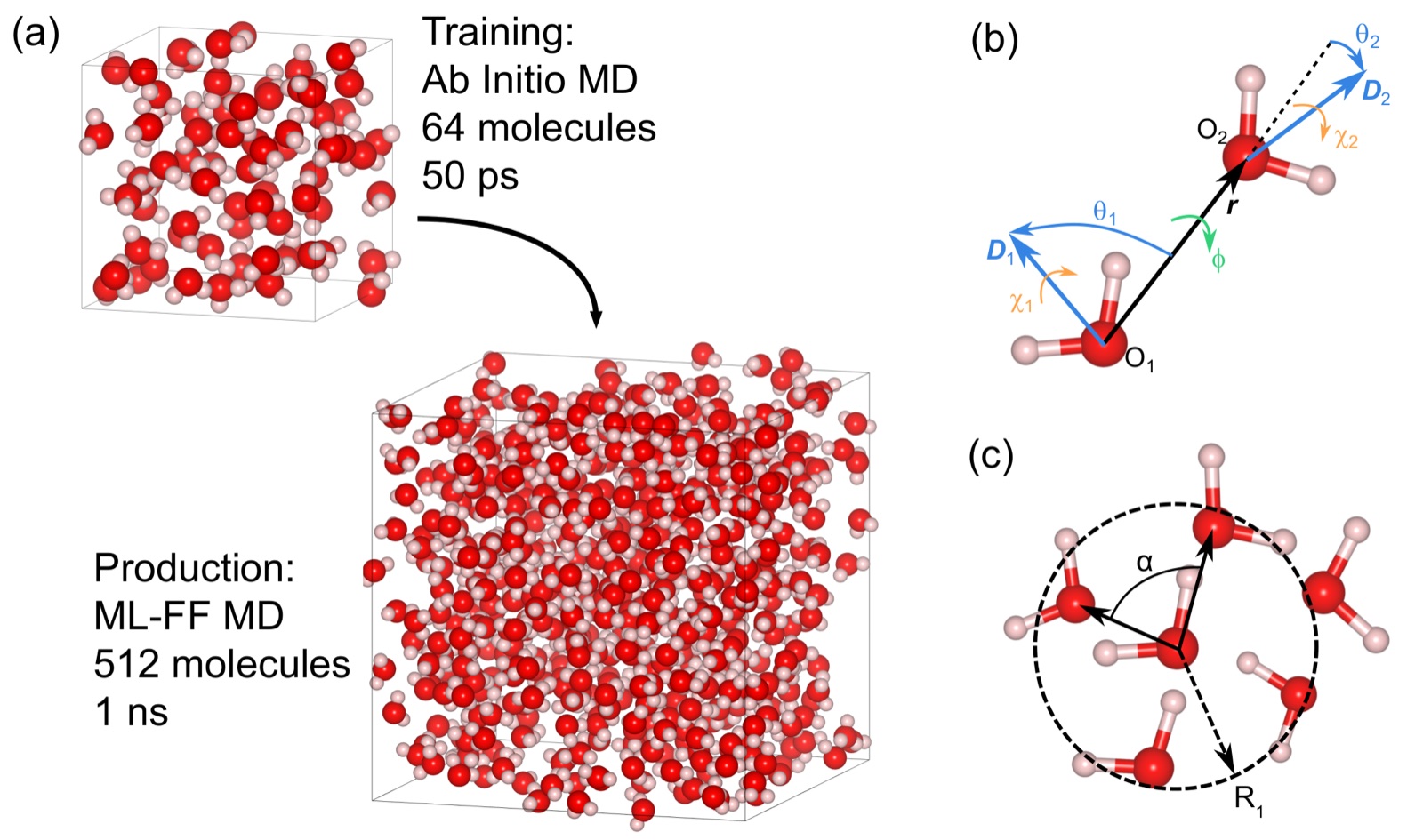
Water is familiar but awkward to model. Each molecule forms and breaks hydrogen bonds with its neighbours many times a second, and the loose, tetrahedral network this creates is what gives water its density, its thickness and the speed at which molecules wander through it. To predict these things from first principles, chemists use density functional theory, a quantum method that works out how electrons arrange themselves. It needs one approximate ingredient, the exchange-correlation functional, which stands in for the parts of electron behaviour nobody can write down exactly. There are many such functionals, and the choice is known to matter.
The difficulty is cost. Doing the quantum calculation afresh at every step of a simulation, for enough molecules and long enough to see liquid behaviour, is expensive. The researchers set out to follow the choice of functional all the way through to measurable properties: how the molecules sit relative to each other, how much disorder the liquid holds, how viscous it is and how fast molecules diffuse. They compared seven functionals against published experimental values and against SPC/E, a long-standing simple model of water.
Where AI came in
For each of the seven functionals, the team trained a machine learning force field: a model that learns the relationship between the positions of atoms and the forces acting on them, and can then supply those forces directly instead of solving the quantum problem again. Training ran on the fly, inside a short simulation of 64 water molecules along a temperature ramp, with the quantum calculation called only on configurations the scheme selected as worth learning from.
The trained models then stood in for the quantum calculation in the production runs, driving molecular dynamics of 512 water molecules. Everything the paper reports about structure, entropy and transport comes from those trajectories. The analysis afterwards — correlation functions, hydrogen bond counts, entropy, viscosity and diffusion — was conventional post-processing, with no further use of the learned models.
Written by AIxSci from the checked record below, to give context for readers outside the field. It is not part of the record.
The work
Technical · from the record
Seven machine learning force fields for liquid water were trained, one for each density functional theory exchange-correlation description, using VASP's on-the-fly learning scheme in a cell of 64 water molecules. Each force field then drove molecular dynamics of 512 water molecules, from which the authors computed the six-dimensional molecular pair correlation function, three-body angle and tetrahedral order distributions, hydrogen bond counts, excess entropy, viscosity and the self-diffusion coefficient, with the classical SPC/E model as a reference. Comparing these quantities with published experimental values, the authors report that functionals without dispersion corrections give over-structured water, more negative excess entropy and suppressed diffusion, that orientational excess entropy varies linearly with the translational component, and that RPBE-D3 agrees most closely with experiment across density, radial distribution function, excess entropy, viscosity and self-diffusivity among the seven functionals. They attribute the similarity between RPBE-D3 and SPC/E to comparable Born effective charges and a shared long-range dispersion form.
How AI was used
A separate machine learning force field was fitted for each of seven exchange-correlation descriptions of water (PBE, PBE-D3, PBE-TS, RPBE, RPBE-D3, R2SCAN+rVV10, vdW-DF-cx) using the on-the-fly training scheme in VASP, in which ab initio reference configurations are generated and the kernel-based potential refitted during an NpT molecular dynamics run of 64 water molecules over 50,000 steps of 1 fs along a 100 to 400 K temperature ramp, with a kernel basis capped at 6,000 functions, element-reduced descriptors, energies scaled to isolated-atom references and the hydrogen mass set to 8 amu during training only. The trained force fields were then used in place of explicit ab initio dynamics to run 1 ns NpT equilibration at 1 bar and 300 K to fix the density, followed by NVT production trajectories of 512 water molecules at 0.5 fs time steps. All structural, thermodynamic and transport analysis — the six-dimensional pair correlation function, marginal orientational distribution functions, three-body angles, tetrahedral order parameter, excess entropy via the Lazaridis-Karplus route, Green-Kubo viscosity and Einstein-relation diffusion with the Yeh-Hummer finite-size correction — was conventional post-processing of these trajectories rather than further model use, and the SPC/E reference was simulated in LAMMPS.
The shape of the work
Structural · the record, drawn
AI
Train one ML force field per XC functional
Fitting model parameters, including fine-tuning an existing model.
ML-FFs were trained for each XC-functional using VASPs on-the-fly-training scheme during NpT MD simulations at 1 barwhere the paper describes this · verbatim
AI
NpT equilibration to obtain liquid densities
Numerical or physics simulation, including where a learned surrogate replaces it. The AI stood in for simulation.
Figure 2(b) shows the evolution of the density during 1 ns NpT simulations performed at 1 bar and 300 Kwhere the paper describes this · verbatim
AI
NVT production molecular dynamics
Numerical or physics simulation, including where a learned surrogate replaces it. The AI stood in for simulation.
Large-scale molecular dynamics simulations with the ML-FFs were carried out using the VASP MD engine in simulation boxes containing 512 water moleculeswhere the paper describes this · verbatim
no AI
Compute pair-correlation and three-body structural descriptors
Encoding data into features, descriptors, embeddings or graphs.
the MD trajectories were analyzed using the full six-dimensional molecular pair correlation function (PCF)where the paper describes this · verbatim
no AI
Derive translational, orientational and total excess entropy
Extracting understanding from model behaviour.
the excess entropy was calculated from the molecular PCFs following Lazaridis and Karplus, and Giuffrè et al.where the paper describes this · verbatim
no AI
Derive viscosity and self-diffusion coefficient
Extracting understanding from model behaviour.
The viscosity and self-diffusion coefficient were calculated from five independent NVT production trajectories for each ML-FFwhere the paper describes this · verbatim
no AI
Compare predictions with experimental reference values and SPC/E
Testing outputs against ground truth.
the root-mean-square error ε with respect to the experimental RDF is noted in the top right cornerwhere the paper describes this · verbatim
What the record says
Technical · every part carries its own basis
+ in the paper~ our reading− not reported
How to read the quotations. A quotation shows where the paper describes something. It does not quote every value beside it: one passage locates a part of the work, and values without their own quotation are our reading of that passage.
All reported structural, entropic and transport results are produced by molecular dynamics run with the trained machine learning force fields; the findings about how the exchange-correlation functional propagates to properties exist only through these learned potentials.
The maximum number of basis functions in the kernel was set to 6000, we used element reduced descriptorswhere the paper describes this · verbatim
Experimental data from Soper et al. are shown in black dashed linewhere the paper describes this · verbatim
The deposited dataset also includes the scripts and code used to process the data and reproduce the analyses.where the paper describes this · verbatim
What this paper did not report
Technical · absence is published deliberately
- Trained model weightsWhether the trained model is available is not stated.
- Version of VASP on-the-fly machine learning force field (one per XC functional)Which version of the model was used is not stated.
- Version of SPC/E water modelWhich version of the model was used is not stated.
- What step 1 replacedThe paper gives no basis for what the AI stood in for.
About this article
Record aix-00142, version 2, checked by a person on 2026-10-09. The record describes the paper; it does not assess whether the paper's findings are right. The paper is published under CC-BY; quotations are at most 25 words. How we work · Report an error